A word on Fintechs!

My wife and I are huge fans of Swiggy Instamart. Reason? Well, it delivers our daily grocery needs at our doorstep within 45-60 minutes and that too with huge discounts. I ordered a big ice cream tub worth Rs 232 and paid a handsome Rs 132/- . I also order large quantities of fried chicken, kebabs and roti worth over 900-1000rs from Karim’s and have never paid more than Rs 500. This is magical.

Similarly, I get deals on Amazon prime as well wherein my delivery is free and timely, mostly a day or two. Amazon pay gives me cashback for making usual payments like buying stuff online etc. On top of that, my Amazon Pay ICICI credit card refunds almost 5% cashback on all transactions.

Now this is insane. They are paying money for things which I would have anyway paid for without worrying about cashback or rewards. Who will not pay his milk bill if there are no rewards on offer? None I believe. Will you stop paying your electricity bill or not book a ticket online for want of cashback? No.

So as far as I’m concerned, these are crazy businesses which are funding my dinners in the hope that one day in the distant future, I shall be so dependent on them that they could charge me whatever they’re splurging now. Well, they’re chasing a mirage. The day I don’t get discounts or at least the price I find comfortable with, I’ll open another app/website funded by the newest VC chasing his own version of Amazon. There’s no customer loyalty nor will there ever be.

In the world of 12GB RAM smartphones and free daily data, how difficult is it to install another app which claims a lesser price! So this whole rally in Zomato post numbers is going to fizzle out very soon and anyone who’s trying to bottom fish believes it is the bottom is going to lose his bottoms!

Let’s come to Nykaa. They’re in the business of selling luxury Beauty products and other related cosmetics to women online and for that they’re hardly making 10crore net profits for the entire year. Last I checked they have opened retail stores in order to reach out to a larger audience. Well, it means they’re trying to become an omnichannel retailer. So in other words they’re trying to do a Shoppers Stop in reverse. Once you open retail stores, the whole story of low fixed costs etc goes down the drain and you’re just another BodyShop or Shoppersstop or Lifestyle competing for the same footfall. Thus, they should be valued similarly.

Shoppers Stop has a net sale of over 2500 crores and a market cap of just over 5000 crore. Nykaa did close to 3800 crores and the market cap is 66000 crores at about 1400 rs a share. So on the test of logic, Nykaa should be valued at best close to 7500 crores Max and that will still be a valuation of over 150 price to earning. Now you don’t get that multiple even if you’re a Titan. So at a lofty multiple of 50 times earnings and even if assuming Nykaa does 100 crores profit in three years, it should be valued at close to 5000 crores market cap which is roughly 100 rupees a share.

And in the end, let’s discuss the Policy bazaar. It’s just a platform through which customers buy insurance. Of course all platforms are valuable if they make money. And in this case, it doesn’t. So for a loss making entity to command a market cap of 30,000 crore is a joke when BSE plus ISEC is under 22,000 crores. With rising interest rates, VC taps are drying out. They don’t have access to infinite cash which could fund their eternal loss making in the name of customer acquisition/habit forming/ growth!

Anyone who’s looking to dabble in Policy or Paytm or Zomato and the likes must be forewarned- All good things come to an end, even Discounts! I dread for the day when I’ll pay in full for my kebabs and milk and icecreams without cashback. It’ll be a sad day for me as a customer. However, anything which is not sustainable will end and so will these companies, atleast most of them.

PS: Amazon after its IPO at $18 per share rose all the way to $90 a share at the height of the dotcom bubble. In three years time, it was down to $6!

Depth of Despair!

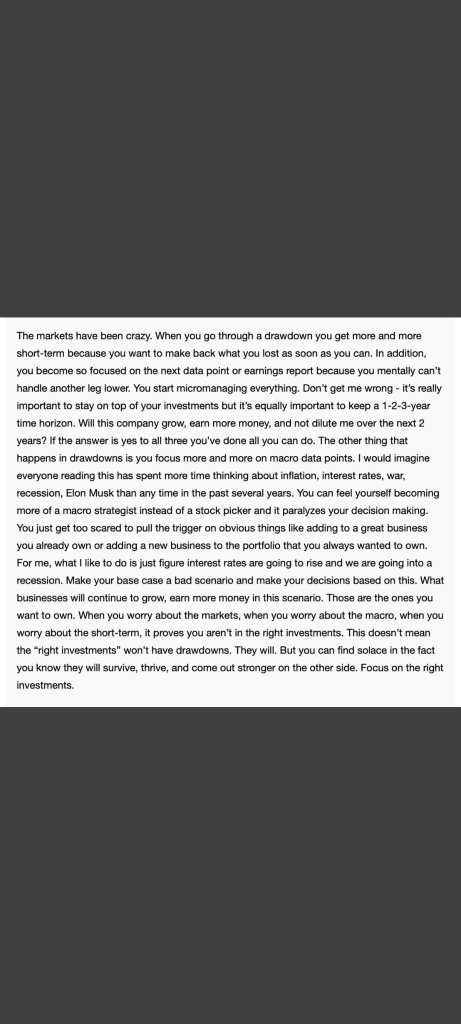
Markets have been on a continuous downward spiral for almost 8 months now. From the highs of October 2021, major indices are down between 15-25% and there is no hope in sight. The newspaper headlines have changed. From loudly cheering the growth stories, they’re now howling about the impending recession, rising inflation, crude prices,etc. GDP projections are being downgraded on a daily basis.

Stock returns are almost zero to negative on a one year basis and major stocks are down anywhere between 25-40% from their recent highs. TV channels, twitter and newspapers are filled with experts loudly voicing a deep long drawn bear market ahead of us. Absolutely no one is bullish on Stocks!

I will be making the same call I gave out last year. India is going to experience a multi year structural bull run, not just in equities but in economy as well. This correction is one brutal Bull Market pullback which is par for the course. It is ensuring that the sector rotation which was badly needed is underway. The last bull run heroes are being mauled while slowly and steadily the new leaders are emerging.

Look at the price movement in Reliance and ITC. Both the heavyweights are trading within 5-10% of their highs and if not for them, nifty would be down to 12-13000 levels. On the other hand, Bajaj and HDFC group stocks are battered. Metals have begun to move south. The bubble levels in speciality chemicals, mid cap IT, sugar, diagnostic companies etc are being deflated. Saurabh Mukherjee’s fund is underperforming so significantly that he’s going around town explaining a concocted term – return holiday in quality stocks. Well, this is just another term for time wise correction. It happened to Reliance between 2007-14 and to ITC from 2015-22. It is bound to happen with HDFC group and Bajaj Twins as well.

Behavioral finance teaches us the importance of being contrarian in light of the madness of crowds. The whole world is fearful of the future. FII have sold out the entire net investment they made between 2010-2021. They have pulled out over $40 Billion in the last 8 months alone. On a much lesser drawdown, our markets were down 60% in 2008. If it were not for you and me, the retail money, nifty would have been at sub 10k levels.

Warren Buffett tells you to be greedy when others are fearful. This is the perfect time for being extremely greedy. Stocks are battered and are being written off. The correction is slow and painful, thus also making sure the required time wise correction is in place along with the price correction. Covid time was a deep price correction but thanks to strong intervention by the governments and the global central banks, there was hardly a time correction. In order for a bear market to end, extreme despondency among investors is necessary.

How does a market bottom out? It bottoms out when there is no buyer. When there is so much pessimism, such negativity that every rally gets sold into and we keep falling back. In that case, anyone who wanted to buy steps aside. Thus, whosoever wants to sell can’t sell any further. We are very close to that point. Nifty has gone down to 15800 in the face of relentless selling four times now. However, at every point, there is some recovery. It is not breaking down any further. The selling exhaustion can be sensed in multiple stocks which are down beyond reason. Isec is down 55% when its profits are up 30% over the last one year. It’s trading at 10 times earnings and 6% yield. This is madness.

I remain eternally bullish on the India story and strongly believe that this too shall pass. We’re in the midst of a roaring bull market and this is nothing but a passing correction. In three years’ time, we might look back and say, oh it was a great buying opportunity!

Compounding- Wealth & Wisdom

May is a special month for me. 8 years ago back in 2014, just a couple of days before I graduated, I ordered my first set of 5 books. It’s been one hell of a journey ever since and I make it a point to read almost a book a week. One year ago, I wrote my first blog on zerotomillion. It’s been 64 such posts in the past one year and I feel thrilled to realise that I’ve begun to compound in writing as well.

There are few things in life I truly believe in. At the top of that list is that Anything one wishes for and dedicates his entire being for is possible. I’m one of those people who actually believes in the law of attraction which I call the law of conpounding- If you do something over and over again for long periods of time, the results are going to surpass even the most optimistic of your wildest imaginations. One of the reasons I’ve been able to survive and somehow thrive in my life is because I’m willing to make ten years commitments. I start something and keep doing it over years together and get better over time.

One of the gifts I had in my life was to be surrounded by people who were far superior than I was in most walks of life- studies, sports, in school, college and at work. However, what I’ve realised is that Will Smith is right- Skill beats talent over time. Skill is acquired by beating on your craft over and over again. Also, a lot of talented people never achieve their full potential because they are good at so many things that they never take that one idea and devote entirely to it. This is why the cool kids in schools or colleges aren’t the ones who end up being a millionaire at 40!

Once you realise the true meaning of compounding and start making it a process of living, you’re bound to be successful. All you have to do is to remain patient, repeat taking small steps and not give up. This is true if you’re lifting weights, reading books or Investing your money.

I’ve a lot of friends who start by saying- I’m a long term investor and I’ll be invested over the next 15 years. Well, that’s a sound idea stretched too far. You don’t need to burden yourself with such a big statement. All you need to do is to say that I’m willing to invest X amount over the next one to three years and come heaven or hell, I’m not going to run away.

The real test of an investor is when the markets are sideways over six eight months, like they are today. Anyone who has been in the market for the last one year is either barely in green or possibly down 10-15%. So those who enter committing ten fifteen years are silently praying for a pullback so that they can sell at their cost and get out for good. The IPO frenzy has also died a gruesome death with most issues from Paytm to LIC being underwater. Even the earlier heroes like Zomato, Nazara, Nykaa are down in the dumps.

So this is what I believe one must remember – Over a long period of time, if you stay invested in equity markets, you’re bound to make a lot of money. However, every other year, there are going to be phases when you’ll just not make anything. If you give up now, you’ll forever curse the markets and regret three years later when something which you sold 20% down went five times up. Even the mighty Amazon has gone down 70% at least thrice in the past 20 years. Imagine the plight of someone who sold Amazon in 2008, only to see it go up 30 times and more.

To my friends who take some inspiration from my journey, all I have to say is to stay invested in life and in equities. There is hardly anybody we know who kept doing something he was doing ten years ago and didn’t give up. You know what we call somebody who actually didnt give up- Great! Greatness is not the preserve of a precious chosen few. It’s possible for you, me and everyone to achieve greatness in our own lives, in a field of our choosing by compounding.

We all hail Jhunjhunwala for holding Titan for the past 25 years. Well, he made his Billion Dollars by not giving up on the idea that Titan can become a lakh crore company.

Happy Sunday!

History Rhymes!

Every Bull market is led by different heroes. The ones who led the last bull market rarely contribute on the upside. We have all heard this multiple times. However, it’s interesting to see this playing out day in and day out on screen. What is happening to the HDFC group stocks or the Bajaj Twins is not totally unexpected.

Markets have fallen in line with the global markets. The US tech stocks which were the darlings leading up to the end of last year have been butchered. Multiple fancied stocks have fallen over 75% while the revered FAANGs have not been left unscathed either- Netflix has gone from 700 to 175, Facebook/ Meta is down 50% while Amazon and Google are down a third each. Even Apple is down more than 20%.

Now add to this the fact that Adani is all set to take over Ambuja-ACC combined and you have an entire episode of 2007-08 playing out with Tata Steel acquiring Corus and Tata Motors acquiring JLR.

What I believe is that a churn is happening in the markets and a new Bull Run is taking steps with new leaders. The old war horses will either start to massively underperform or will move sideways for years to come. We have seen this in the past as well. The technology stocks did nothing for the first decade of this century after running up all the way to moon and back- Microsoft, Infosys and for that matter even HUL went nowhere for a good 7-8 years period. Similarly, Reliance went nowhere between 2007-14 while ITC has only recently begun to crawl.

So my bet is that the current lot of quality stocks- Asian paints, Berger, HDFC twins, Bajaj Twins etc will languish while the hot stocks such as IRCTC, Apollo hospital, Page etc will either fall 50-70% or will do nothing for the next 5 years. The game has moved on and so shall we.

As far as the new age companies are concerned – Paytm, Zomato et al are still hugely expensive and will go down at least 50-60% from here. The only thing I managed to learn from this carnage is that our MF managers do nothing special but to buy what’s going up! I used to admire Ramdeo Agarwal a lot for his conviction and quality picks. However, when I realised he has been buying Zomato and Policy and such a lot just because they’re moving up and came out on TV to justify the same, I lost quite a bit of respect I had for him.

In a market where junk flies the highest, the temptation to buy is enormous. I remember being asked if Zomato is a good buy and after having said no it’s not, to be almost mocked because the price went up 2x in three months. Well, I’m happy that I didn’t succumb to any such feel good story. A lot of people who thought Paytm is a great buy at 1200 or at 800 or even at 550 are yet to learn history lessons taught in the case of Yes Bank, Jet Airways and Suzlon.

Coming back to the Adani deal- I sense this massive $10B deal will formally mark the end of this commodity/metal/cement run in India. As I’ve iterated earlier, all these deals mark the end and not the beginning of a massive up cycle. It will be interesting to see how Adani group stocks fare over the next one year or so.

ITC has been the story of this correction. I’ve sensed in an earlier blog that maybe it’s ripe for an upswing and that feeling is being proven correct. The fact that it’s up 20% when the market is down 20% in itself shows which way the wind is blowing. Reliance too seems to be ready to lead this rally.

Some of the great stories such as Insurance, Credit cards etc were massively overpriced throughout the past five years. Similarly, Dmart, CAMS, IEX etc were beyond the reach of any sensible investor. I reckon in two to three years, some of them would be reasonably priced, just the way HDFC AMC is trading below its listing price after four years of IPO. This market may give us some opportunities in the near future.

As is our ritual, let’s talk about what I’ve been reading- Ambani and Sons is a fantastic read for anyone to understand how India looked 30 years ago and how privileged we are to not be living in those times.

PS- here’s a video from October 2008 when the world was literally falling apart. https://youtu.be/dcA9zGoAUhM

It’s interesting to see what our heroes talked about when they didn’t know if the world would survive. What stuck me is the ticker price showing Bajaj Finance at 50, ACC at 400 and Bajaj Finserv at 130! Now in hindsight it’s easier to say oh everybody knew Bajaj Finance is such a great stock. How many actually bought it at that price is the real deal!

Weekend musings!

A lot has happened in the past week. Both the US and Indian markets have fallen sharply following rate hikes by global central banks to address the rising inflation challenges. As you know, I don’t worry about the macro scenario so will not spend much time on what we already know- volatility is the nature of the beast and markets will move up or down for whatever reasons. Today I would rather talk about three things- startups, Reliance and of course the overall scenario!

The past six months have been brutal for new age tech companies across the globe. Be it our Paytm and Zomato or doordash, zoom etc in the US. Paytm we all know is going to zero very fast and is now joined by Zomato which is down roughly 66% from its all time high and over 50% from listing price. Zomato is now finally selling for the price of 1kg tomato! The beating in the US is much worse- Zoom down 75%, PayPal down 75%, Ark ETF down over 75%, the mighty Amazon down over a third and the list goes on and on. The idea that only tech will survive and everything else will forever stay in the dumps is being challenged.

Closer home, I was wondering how these startups find a way to lose money in businesses where making money is guaranteed by the nature of the game. In stock broking businesses, whether you buy or sell, lose or win, house takes a cut, period. Thus we are betting heavily on Isec, BSE etc. Now you have newer players like Groww and Upstocks funded largely by private equity losing money to attract customers! Wow! It’s like the Umpire in a cricket match getting out LBW! It sounds incredulous but true. The full year revenue for Groww is hardly 5cr rupees and it boasts one of the highest retail customers! So basically it’s a casino which allows people to gamble on its own account so that it can claim higher footfalls! Incredible!

Similarly, I am amazed by the way these grocery and food delivery companies operate. They deliver free of cost on the same day, some even in a few hours and charge much less than the retail price of fruits, vegetables or groceries and offer cashback! Wow! I mean, the smallest of the fruit vendors makes at least 30% on his cost and these supercharged masters of the universe lose money! How beautiful! Of course as a consumer I am delighted with their services but would never invest in their stocks.

Let’s now discuss Reliance! If ever there’s a company which embodies scale, this is it. The annual trunover for the whole year FY2022 is over $100B! Its profits for the year is over 67000 crores which is higher than sales of almost 99% of the listed companies in India! In an earlier blog, I mentioned how Reliance can grow to almost a Trillion Dollars company (https://zerotomillion.business.blog/2022/01/10/is-the-new-amazon-amongst-us/) Reliance retail is now doing annual sales of 2lakh crores! Just for reference, let’s compare it with other much more fancied retail chains- Titan did around 29k in sales and 2200cr in profits. Dmart did similar sales with around 1500cr in profits. Titan has a market cap of 2l crore and Dmart is at 2.4l crore, even after 40% correction. Reliance retail did 2l crore in sales and over 7000 crores in profits. This is twice the combined profits of the two behemoths. Take a deep breath and absorb this fact!

Airtel has annual profits of close to 5000 crores and sales of roughly 1.1l crore in the trailing twelve month period. Jio did sales of 95k crores and net profits of over 15k crore! Almost 4x of Airtel. And Airtel has a market cap of 4l crore!

So once you add Reliance in your portfolio, you basically have Titan, Dmart, Airtel, ONGC, speciality chemicals ( Reliance is one of the largest petrochemical companies in the world) at a market cap of 17l crores which is a steal compared to the valuations market is according to some of the stocks I mentioned earlier. I was all too happy to add some of it when Russia invaded Ukraine and it fell back to 2200 types.

Investing requires us to be patient in times like today’s when the bluechips fall massively and begin to underperform, markets trade sideways for months together and there is pessimism all around. What I do is to read more. I recently finished the Ambuja Story, autobiography of Narottam Seksaria, the founder of Ambuja Cements. It’s a fantastic read about someone who dared to dream big in the 70s and 80s in a socialist India. Anyone who believes India is in the doldrums needs to revisit where we were 40 years ago and how we survived the ugly days of state control. You may also like to pick Ambani and Sons by Hamish McDonald which chronicles the story of Dhirubhai Ambani. These two gentlemen are first generation entrepreneurs in days when India was a hungry third world country. In one generation, both of them became Billionaires. This is what I believe – bet big on India, it works! https://zerotomillion.business.blog/2021/05/24/bet-big-on-india-it-works/

Market whispers!

It’s 2007, the world is in a multi year commodity bull run led by China’s insatiable demand to construct now what we know as Highways to nowhere. Fuelled by higher share prices and soaring profits, Tata Steel acquires Corus, the UK Steel major. Hindalco acquires Novelis, another major global alumina giant.

It was anticipated that China’s rise at the breakneck speed of almost 10% per annum is the new normal. All major commodities, ferrous and non ferrous traded at lifetime highs. The music was getting louder and the party seemed unstoppable.

Come the 2010s, the world is still reeling under the aftermath of the global financial Crisis and the China story is shaky. People are beginning to whisper of a hard landing in China, metal stocks are down and both the deals which were touted as arrival of India on the world stage are now being found wanting!

It took Tata Steel almost a decade plus to cross its highs made at the top of 2007 bull run and for the entire period, most metal stocks were shunned altogether by investors. This is typical of all deals done at the top of the metal cycle. What I believe and sense is that the end of the current bull run in metals might not be too far away..

Recently, Holcim announced its intention to dispose of it’s stake in Ambuja and ACC at the tentative deal valuation north of $10B. This was followed by media reports claiming interests from JSW group and Adani group to bring the cement companies under their fold. What is interesting is that JSW plans to fund part of the deal by mortgaging some of it’s stake in JSW Steel and JSW Enegery, both shares trading at decadal highs, fuelled by this post Covid commodity dream run.

History rhymes, if not repeats itself. The stocks of old economy stocks such as Steel, cement etc were shunned by investors for almost a decade before making a splendid comeback in the latter half of 2020. Experts are lining up to urge the public to allot major parts of their portfolios to metal stocks as they promise rising profits and higher dividends.

Once the cycle turns sour, the profitability of metal and all commodity stocks goes down sharply as most of them have very high fixed operating costs and margins vary wildly based on current market prices of the underlying commodity. Like it or not, the deals are done mostly at the top of the cycle because that’s when balance sheets look strong, it’s de-leveraged and analysts are more likely to assign a higher EV-EBITDA valuation.

Howard Marks has highlighted this in his fantastic book Mastering the Market Cycle. It’s illuminating to see how investors are extremely greedy at the top of the cycle and horrified at the bottom. The key in investing is to be the opposite – be fearful when others are greedy and be extremely greedy when others are running for cover.

It’s going to be very interesting to see how this story unfolds!

The Big Picture!

Today I would like to talk to you about two kinds of people in India. The first kind are the learned class, the intellectual types with good degrees and plush jobs, the kind you can find in offices around you. If you ask them- is India growing/getting richer/ on the right track? The first reaction would be a 😏.

If you probe them any further, they’ll tell you everything that is wrong with India. High inflation, joblessness, growing social tension, higher crude and commodities prices, rising inequality etc. This is the standard answer I generally get from most of my colleagues. And to prove their point, they’ll give you data and reports in droves, especially from the “reputed” international organisations and non-profits such as Amnesty, UNHRC etc.

What I generally ask after this is if they’re investing their money in stocks. More often than not, the answer is that hardly a part of their net worth is invested in equities. The two aren’t interrelated and am not drawing any conclusions but are just a reference point for further discussion.

On the other side are some people who are perma- bulls. Here’s a speech from Gautam Adani who said India is likely to eradicate poverty by 2050 and can have a $28-30 Trillion economy by then. A back of the hand calculation shows that it assumes an average growth rate of roughly 8% over the next 28 years. Here’s a link (https://twitter.com/ETNOWlive/status/1517145792594968578?t=Icdo1Qp89btcZdPUw1AmUQ&s=19)

The moment you tell these things to the first kind of people, you’ll be mocked, ridiculed and possibly shunned altogether. They are going to quote experts and organisations and who’s who or everywhere as to why India is never going to grow that large and why we’re not even growing right now and all the data published by the Govt which says we grew at 8% last year is a sham and what not.

Now here’s my take on this. If you ask them how many companies these experts run or have created? The answer is Zero. How many of such experts are self made millionaires, the answer remains to be zero. If you also ask them if any of their types even believed India was likely to survive the Covid pandemic, the answer still remains to be Zero. I call these experts Doomsday predictors. Fortunately, they don’t matter.

If you follow any of their advice, you’re most likely to never bet on India and will forever stay off from investing in the humongous wealth creation we’re likely to witness over the next generation. Choose your gods wisely.

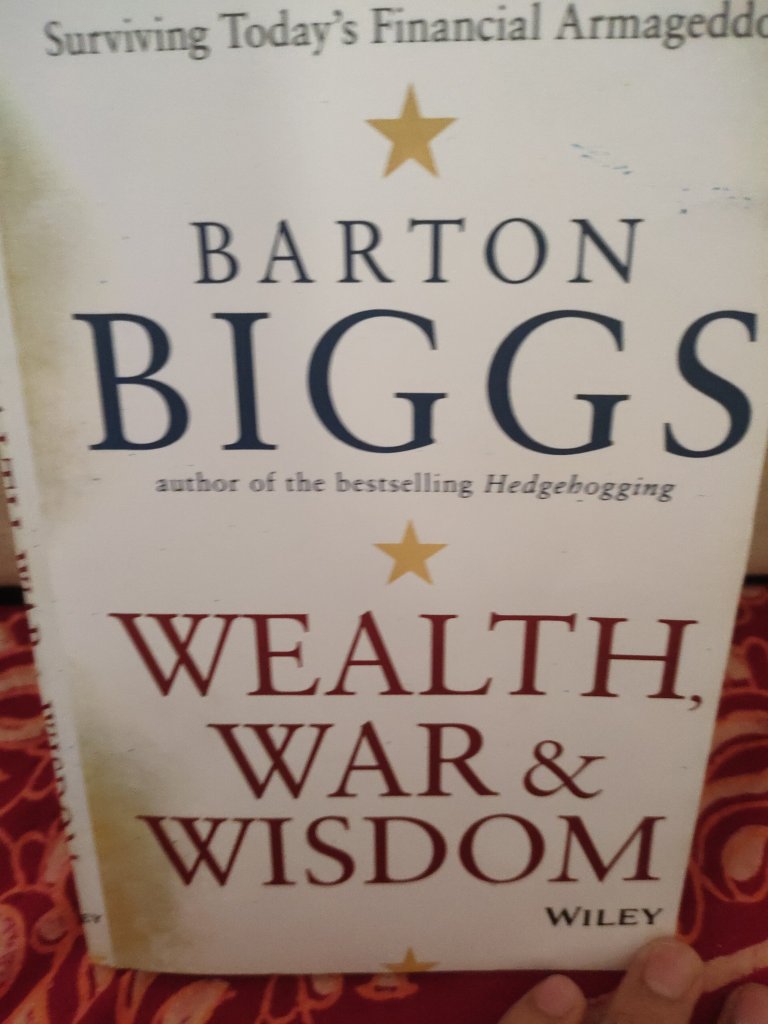
Let’s talk about another idea. I’m reading this book about the performance of equities during the second world war.

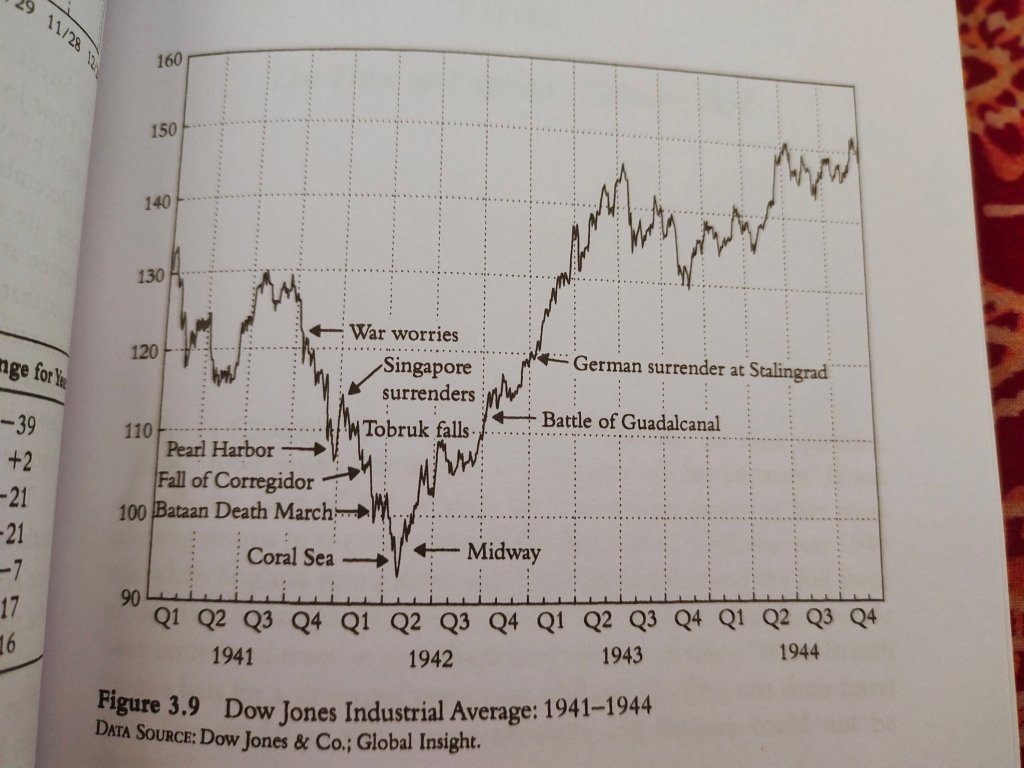
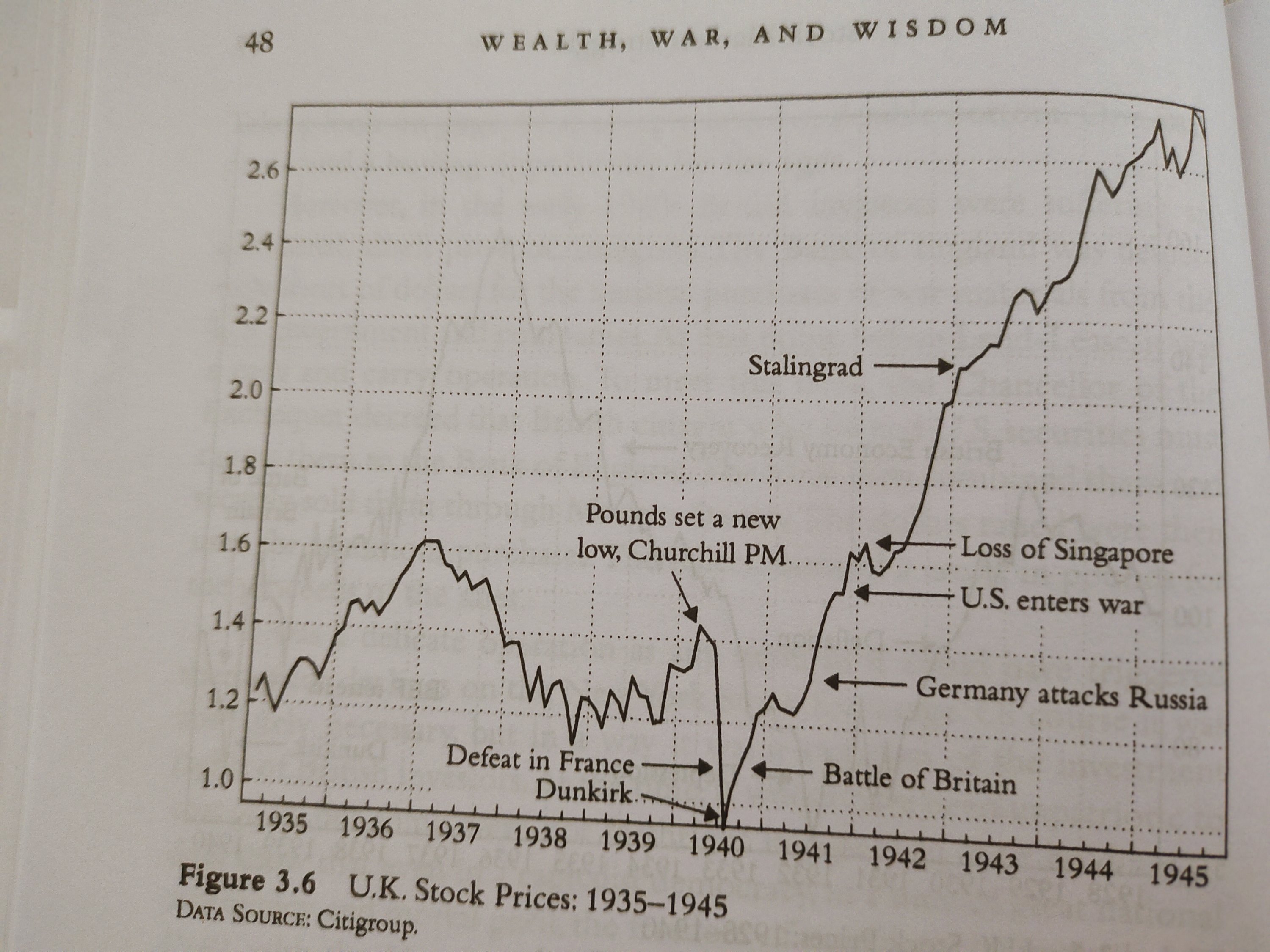
The most interesting thing which I took from this is that surprisingly, US, UK and German markets could sense which way the war was heading before even the generals and the political leaders knew. The UK market bottomed in 1940 when Britain was the weakest.The German market made its top much before their armies had even faced a significant retreat, much less a defeat and similarly the US market made its bottom when everyone knew that the US was losing the war. Take a look below:

The important takeaway is two: market bottoms are made at the point of maximum pessimism i.e. when you’re fearing apocalypse. After that, the market moves up not because the news is good or better but because it’s less bad than what is already known. Similarly, market tops are made at the point of extreme ebullience. Once that point is reached, it can only get worse from there.

It helps us understand why the market made its bottom on the day of the first lockdown in 2020 and not when the damage was done two months later. It also helps us understand why on February 24,2022, the recent panic low was made.

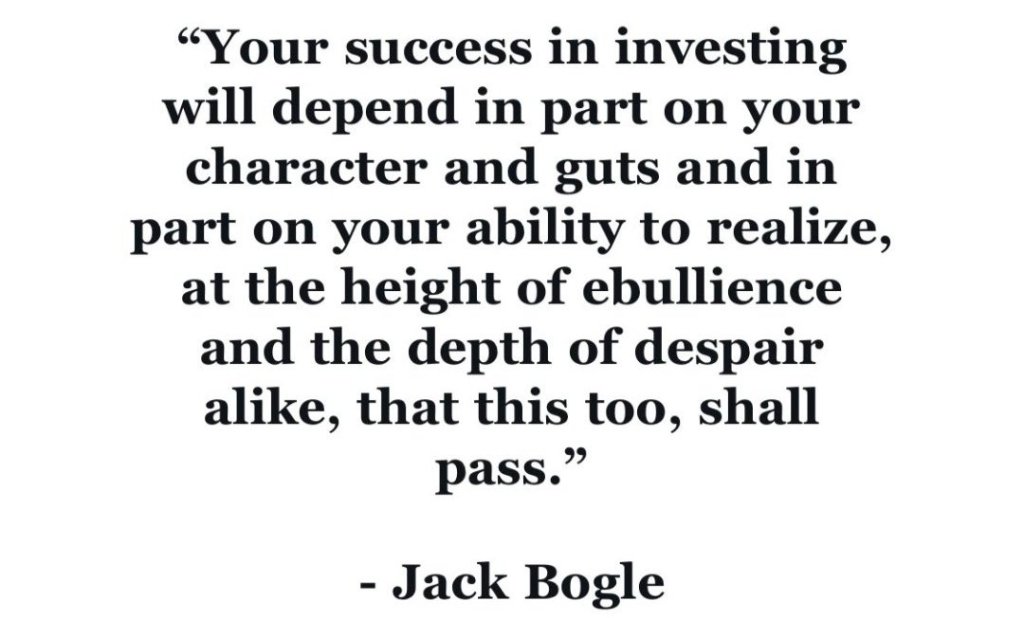
The point I’ve repeatedly made is to buy heavily when the markets fall and buy your heaviest when the world is collapsing. Here’s what Jack Bogle had to say

This sums it up the best!

PS: Since we are discussing experts, let’s also discuss the stock market gurus we watch on CNBC and on twitter. On April 4, when the merger of HDFC with HDFC Bank was announced, there hardly was anyone who didn’t go ga ga over the brilliance of the move. Every channel and its anchor and every expert worth his salt came out and said, the days of HDFC group’s underperformance are over and the upswing is just the beginning. They explained in detail how this will lead to low cost of funding and finally take the shareholders to the proverbial land of milk and honey.

Cut to yesterday, both the HDFC and HDFC Bank are down 15-20% from the merger day’s high. The same experts are now justifying why the merger isn’t that big a deal and why the group is likely to continue to under-perform over the next two years. So much for market genius!

Try watching this on YouTube by digging into the library of CNBC TV18 or just typing HDFC Bank merger news. It’s funny!

What are we seeing!

Today’s market was funny. Reliance is trading close to it’s life highs while the HDFC group is underperforming big time. Similarly, ITC is getting its groove back while HUL, Nestle and Britannia are going nowhere. So what’s happening!

My sense is that there is a slow but definite churn in the market. If you follow the nifty index constituent weights, you’d have observed that Reliance is now almost 12% of the index, while for most of the last three years, it hovered around the 9-10% mark, closely followed by HDFC Bank. HDFC Ltd is not in the list of top ten companies by market cap while ITC is over 3.1% of Nifty 50. HUL which was almost 4% is down close to 2% while Nestle and Britannia have returned close to zero over a 2 year period.

The high of the last bull market was the corporate tax cut in September 2019. If you take returns of the market darlings from that date, the returns are much less than the market. NIFTY 50 is up over 55% while Nestle is up just less than 25%,HUL is hardly up 10-15%, HDFC limited is at the same price it was in September 2019 while HDFC is up just about 10% . Reliance is up over 100% over the same period.

What is happening is that the law of averages is catching up with the erstwhile quality must own stocks. This has happened in the past and will happen again. We’ve heard this multiple times that every bull market is led by different leaders. Similarly, this won’t be led by the HDFC pack or the Nestle and Levers of the world.

I read somewhere that the only thing new to learn in markets is the history we are yet to read. Everybody who is perplexed by what’s happening in the market must go back and read market history. In the Indian context, there’s a quick and witty book by Santosh Nair titled- Bulls, Bears and other Beasts. Read it and you’ll get some perspective.

In a market which is now down ten percent from its highs and has languished with relentless FII selling, Ukraine war, rising inflation and what not, the best way is to do nothing. The stocks you own are minority stakes in living businesses and a business does not lose ten percent of its value in a day.

What we are seeing is massive crowds thronging the marketplaces, highest ever exports, long queues to buy premium cars, movies making 1000 crores and sold out hotels. If you don’t believe me, just try going out on a Friday night and count the luxury cars you see in Jaipur or any other city, try to find a parking space in any mall or try booking a hotel for a weekend getaway. Of course if you ask the experts, they’ll scare the hell out of you. Well, which of the experts you know drives a Jaguar? None and that’s the point!

What we are seeing is a growing number of people paying a premium to join better gyms, shopping more and from the higher end brands and the erstwhile luxuries are the new necessities. I personally didn’t own an AC until two years back and since then, between me and my in-laws have purchased 6 of them and everything you want to buy is out of stock! A friend of mine is waiting for three months to buy his automatic Nexon and the reason is not the semiconductor shortage but real demand. Anecdotally, people are using connections to get their hands on a new Tata car by leapfrogging others in the waiting list.

What we are seeing is that the organised retail is shooting through the roof and this I have experienced first-hand, having purchased clothes and toys for my newly born niece.

To experience the above, you don’t need an expert. Just open your eyes and look out. India is growing richer. There’s a reason why Reliance is trading at life high in this down market!

Investing is a loser’s game!

I recently completed this fantastic book called Invest like a Dealmaker by Christopher Mayer. It included the captioned quote from another investing legend which basically means successful investing requires one to avoid making mistakes and make the most of other people’s mistakes, as in amateur Tennis where all you need is to roll the ball over the net to keep going. This is unlike a winner’s game such as professional Tennis where you need to be skilled enough to win on your own.

So today I look back at some of my mistakes, flops and disasters which toughened me enough to keep going.

It was early 2018 and I began to invest in a company called Reliance Home Finance. Yes, ADAG group of all things. I prided myself on having read the Intelligent Investor and had recently learnt to read the Balance Sheet. My first investment was made at 107 and when I finally got out in March 2020, it traded at the princely sum of 95 paisa! I lost 99.99% of my money and a total loss of over 1l. So what went wrong?

First of all, I bought junk which turned into shit. I didn’t care to see that the group had begun to default on its other debt obligations and claimed foul that it had nothing to do with its own shortfalls. Funnily, I kept hinged on its book value which was over 50rs at the time of my purchase. One lesson I learnt was that a lender’s book value can vanish overnight when debt came calling and it had nothing to pay. This did happen and once its asset value went south, book value meant nothing!

Secondly, I learnt to never buy junk! In a world where you can choose from 5000 stocks, why waste your time praying for a bad group to turn out sober.

Another huge flop for me was Yes Bank. I lost almost 99% of the invested capital for similar reasons as mentioned above. I remember the sigh of relief when I could exit at around 8Rs in March 2020 that at least my portfolio was cleaned off all the shit I carried in the name of Value Investing.

Here are my takeaways( https://zerotomillion.business.blog/2021/05/26/dont-buy-junk/) It is of utmost importance to avoid losing money. This does not refer to the notional stock price decline which happens as a matter of fact. Loss/ Risk is defined as the possibility of permanent loss of invested capital. So once you learn the art of saying no https://zerotomillion.business.blog/2021/06/12/art-of-saying-no/, you narrow your list to such stocks which have at least more than a fair chance to survive and thrive over a three five year period.

I also made a thumb rule to avoid lenders. This goes against the investing wisdom prevalent in India where Banks form almost one third of the key indices and HDFC Bank and Kotak are touted as the cornerstone of a sound portfolio. Well, why I differ is that I hate businesses where you call a sale as money going out of the door. This is exactly what happens in lending businesses. You borrow short term deposits, and lend long term, praying for money to come back on time,if at all. What I love are the non lending financials. They are the cash generating machines. You can’t trade without putting in the full amount needed with your broker and win or lose, he makes money. The MF guy takes his cut before he invests on your behalf. BSE gets the cut irrespective of the market moving up or down, every day of the year when the market is open! I simply love them!

The fact that I could learn to buy them and didn’t fall for a PNB which my broker almost begged of me to buy at 60, and again at 40( now still trades thereabouts) or a Jet Airways is because I booked that loss of over 2l which by the way still shows in my ITR. I learnt to book a loss as it cleans up your portfolio and also is tax efficient. Your loss can be carried forward up to 7 years and is set off against equal gains made subsequently. Also, booking loss is painful. So next time you’re very careful to avoid such traps.

I also have learnt to give up on the idea of beating the market. Every great Investor who has survived the game for over 10 years tells you that he has lagged the market for multiple years in a row but one or two great years eventually make up for everything. Also, concentration is essential. You can’t win big by betting 1-2% on your best idea. Unless you back up the truck on your best idea and see it grows to almost 50% of your portfolio or even more, it won’t make a difference to your networth( https://zerotomillion.business.blog/2021/06/07/growing-your-capital/)

PS: one stock which I followed quite closely, bought and then got out is Care ratings. It ticks all the boxes, Guy Spier owns it, Crisil bought 9% at 1600, business is strong. However, I just couldn’t add to my portfolio as whenever it fell further, something like an ICICI SECURITIES also fell. Everybody except Buffet runs out of cash buying the dip. So I thought it was wiser to add to an already substantial position of an ISEC or TaMo rather than trying to create a new position in Care. This is a lesson on capital allocation one must learn- you only have so much money. Spend it wisely!

The Holy Grail

We all have heard investing folklores of how if you have purchased Eicher shares instead of buying a Bullet motorcycle, you’d have enough to own a BMW or if only you had bought TCS in the IPO, it would have made you a millionaire. The idea is to underline how stocks can generate wealth for those who own them.

If I try and define the holy grail in investing, it’s going to vary person to person. Someone would say beating the market year on year is the ultimate objective whereas someone would define it to be able to make a quick 20-30% on invested capital. However, I define the ultimate objective in investing is to own stocks in a company which you don’t need to sell to book a profit. The stock should just lie patiently in your demat, going up atleast 10-20x in 10 years and returning multiple times of the original capital as yearly dividends.

Now you’ll wonder, does this thing really happen in the real world to people like us. The answer is, yes it does. It not only happens to someone like a Rakesh Jhunjhunwala who owns over a Billion dollar stake in Titan at an average price of less than 10rs and whose annual dividend would be much higher than the amount he invested. It happens to people like us too. Look around for people who owned small shares of Hero, Reliance or TCS and forgot to sell. The shares have gone up more than 500x each with an annual dividend much higher than what they put in to buy those shares.

Also, investing is not about beating the market. This is the one myth which needs to be busted and buried. I’ve gone up more than 5x since the end of 2019 and over 3x since August 31,2020 at a consolidated portfolio level. If I was just trying to beat some arbitrary index, I’d have less than half my net worth today. I stumbled upon this fact almost accidentally. Those who know me closely know that I keep a journal. Going through old logs, I realised my portfolio has gone up more than 100% annually in each of the last two years, of course with some additional capital which I invest. However, this proved to me that going up from 1x to 4x is real and doable.

Our mind is accustomed to thinking in straight lines in terms of growth. So if we have 10l, we think it might grow to 12/15/20 in some years. However, compounding is a different beast. It begins to grow exponentially which our mind can’t fathom. So for someone investing 10l, it’s extremely different to think how her portfolio will look when it crosses 1cr. Similarly, we can’t even imagine what can happen if some of our stocks go up 10-20x.

I’ve previously discussed what Nick Sleep achieved in Amazon or how Jhunjhunwala simply sat on Titan and became the billionaire he is today. This thought was recently reinforced by a brilliant book called the 100 Baggers (image below)

I strongly recommend everyone to buy and read this as soon as possible. The idea enumerated is how we should aim to own stocks which can possibly go up more than 100x from their initial invested price and how this is the best way to generate wealth. Like Mohnish Pabrai said recently in a recent video- the idea is to find a CRISIL and go to sleep for ten years. Once you own something which has a huge runway ahead, the best thing is to leave it alone.

Another book by the same author which I’m reading is called Invest like a Dealmaker. The idea is that while valuing a company, you should look for what another company or a person would pay to buy the entire company in question in a private transaction. This helps you to think in terms of owning minority shares in a business and not just look at the quoted stock prices we observe on our screens.

My learnings over the past two years have been to identify businesses which have a huge runway ahead of them in a growing India, are on the right side of technology and fall either in a rising consumption by a richer Indian middle and upper class or higher investment by the same people. This helps me avoid a lot of companies and saves a lot of work. Further, by using the art of negation, I also avoid anything which I can’t understand without a calculator or with my already developed knowledge base. If I have to read computer programming to just understand a company’s business model, I’m best served by avoiding the stock.

On top of this, which I have articulated in earlier blogs, what I now am looking for is businesses to own forever. Of course, forever seems too far stretched but the idea is to not even worry about price movement, favorably or adversely. I was actually happy when TaMo recently fell 30% as it helped me add to the already built position. Similarly, I fail to understand how ISEC is available at this price. All of the stocks I currently own, including Hero are here to stay.

So combining the two, we should aim to look for businesses which can flourish over the years so that not selling remains the best idea. Further, in order to get over the anxiety of stock prices going up and down on a daily basis, we should always value the stocks as minority ownership stakes in living companies so that our vision aligns with those of the management. I was very happy when a few days back my father told me that we may possibly have to never sell BSE. He owns few shares and has seen it grow 5x from his price. I fully agree with him and like I always say, my BSE shares are not for sale.

PS: Here’s an update on what I wrote about Hero in the last blog- The IT raid story died soon enough and if there’s one news we all must follow is that of EV two wheelers of a lot of brands catching fire across the country in multiple incidents. This makes life of someone like Hero Moto much easier as who would buy an Ola or Okinawa which catches fire. Trust is the most important constituent in mass EV adoption. Also, Ather is almost 40% owned by Hero and there have been no such incidents reported against Ather. Thus, my thesis stands.